Castlevania Belmont’s Curse review: a great whip and a clumsy map
Evil Empire’s Metroidvania has whip play that is a joy to use and a huge Paris to explore, but distant save rooms, heavy platforming and a clumsy mirror fast travel wear on you.
Quick answer
Belmont’s Curse has excellent whip play and movement, a huge connected map of Paris and a low price. Save rooms that sit far apart, a clumsy fast travel system and too many platforming gauntlets keep it from being an easy 9.
Belmont’s Curse is a 2D Metroidvania set in Paris in 1499. Rose Belmont, daughter of Trevor, goes after a castle that has appeared over the city. Evil Empire made it for Konami with Motion Twin advising, which is the Dead Cells crowd, and Rose moves like it.
It costs $29.99 (£24.99 or €29.99) and the story takes about 15 to 20 hours. Rose levels up, finds weapons and relics and fills in a map that opens as she earns movement abilities.
| Detail | Castlevania: Belmont’s Curse |
|---|---|
| Developer | Evil Empire, with Motion Twin advising |
| Publisher | Konami |
| Released | 15 October 2026 |
| Platforms | PC (Steam and Xbox app), PlayStation 5, Xbox Series X|S, Nintendo Switch |
| Price | $29.99, £24.99 or €29.99 (Midnight Edition is $39.99, £34.99 or €39.99) |
| Length | About 15 to 20 hours for the story, close to 30 for everything |
| Mode | Single-player |
Whip combat and movement
The whip is the best thing in the game. Rose gets the Arcane Whip from the first boss, and from then on it is a weapon and a way to move. Glowing anchors let her swing across gaps and gain height, sharpened anchors pull her in, and it can hook an enemy to cross a gap, or fling Rose at one for an air strike. Chaining swings, slides and hops through a room feels quick and clean once the timing settles. No Castlevania has felt this good to move in for a long time.
Rose starts with three moves and never has to unlock them. A held jump carries her further, a wall jump lets her cling and push off, and the slide squeezes her under low gaps and ploughs through enemies on the way. The whip builds on those.
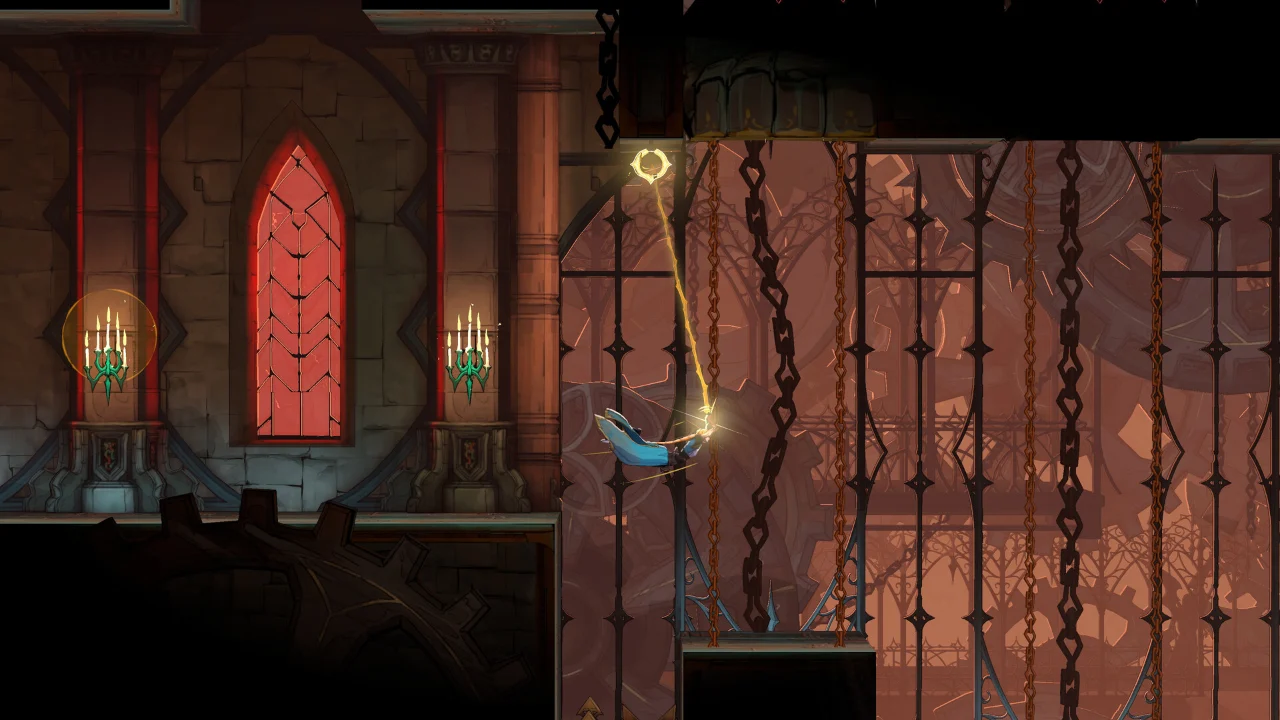
Four more abilities arrive from bosses, and each one is a different tool. Holy Light breaks the rocky growths that block routes and doubles as a parry, Smash breaks gold-cracked blocks from above, Aerial Rush is a mid-air dash and Double Jump adds height. Every one of the movement abilities has its own gate on the map, so the game keeps handing you reasons to go back to places you have already cleared.
There are 28 weapons, spread over seven families, and the families are fists, spears, whips, dual swords, sword and shield, and one-handed and two-handed swords. Every family runs through four tiers at 25, 50, 75 and 100 attack with a combo finisher of its own, and each legendary weapon adds an effect. One sets enemies on fire, another teleports Rose as she attacks. A higher tier in a family means more attack, so the main choice is which family suits your style. Seven styles is a good number. Swapping means opening the Equipment menu, and a quick swap would suit the pace better.
The families play differently. Whips want the tip to land, two-handed swords want you to hold the button for a charge, and dual swords keep a combo alive as long as hits connect. One-handed swords hit harder out of a backdash or a slide. Spears get thrown, fists snowball with every consecutive hit, and sword and shield soaks up hits from the front while you hold attack. Fists reward aggression the most. Sword and shield is for players who would rather not dodge at all.
Enemies rarely flinch. Most of them hit you through your own attacks, so trading blows is a bad plan and the slide, the dodge and the parry all earn their place. Anyone who learned on Dark Souls will know the lesson already. Stop mashing. The archers in the first hours take a lot of health for what they are.
Boss fights hand out tarot cards called Arcana, and these work as Rose’s special attacks. They cost mana, which drops from candles and lanterns, and each one can be upgraded by finishing small tasks the game calls Works of Mercy, such as casting it a set number of times. Chains of Justice holds nearby enemies in place for four seconds and does the same to most of the bosses worth worrying about, so pick it up early.
Exploration and the map
Paris is the best piece of design in the game. The map is one connected space that fills itself in as you explore, and it climbs and drops through sewers, a cemetery, a prison tower, catacombs, a clock tower, a library, Notre-Dame and about a dozen zones in all. Each zone has its own look and usually its own gimmick. Routes loop back on themselves, shortcuts open from the far side and nearly every locked door points at an ability you do not have yet.
Brave Heart and Wise Heart fragments, collected in fours, raise health and mana, so side rooms are worth checking. Puzzles are the other reward. Star charts, an organ and a scales test all ask you to work something out with very little help, and most of them are fair.
Item hunting works differently from the older games. Candles and lanterns drop mana and small heals, enemies give XP and little else, and there are no hearts or sub-weapon pickups. Rose heals with flasks that refill at mirrors, which also act as save points and bring the enemies back. Relics are passive buffs that trigger on conditions, and three slots force choices. Levels raise attack and defence, so clearing a zone properly pays off twice, once in loot and once in XP. Areas get a gold border on the map once everything in them is found, which helps the cleanup pass.
Platforming
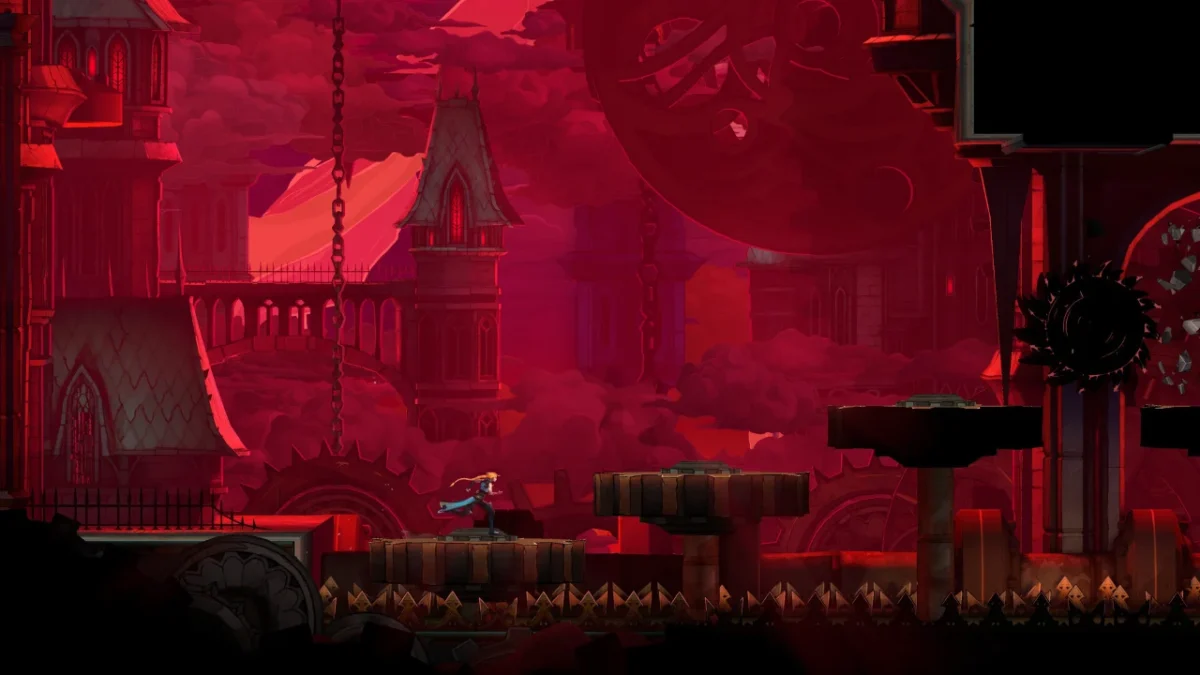
There is a lot of platforming. Gauntlet rooms full of saw blades, spike pits and crumbling platforms sit in every zone, and they guard most of the optional upgrades. The whip makes them good fun early on. They can end up taking more of your time than fighting does, and the saw-and-spike layouts start to blur together. The hardest ones combine swinging with platforms that fade in and out, and others are long runs of saws and spikes.

A failed jump costs a sliver of health and a short respawn nearby, so none of it is punishing. It is just a lot. Players who came for the fighting will spend a fair chunk of the game jumping over saws instead.
Difficulty and settings
Difficulty is front-loaded. The first hours are the hardest, because Rose is low level and enemies hit through attacks, and the first boss ends the tutorial with a real wall. Levels help a great deal against normal enemies and much less against bosses, which have to be learned. Once Rose has a few levels and a decent weapon the game relaxes, and the second half is noticeably easier than the first.
The options are generous. Damage dealt and taken, XP gained, trap damage and the number of healing flasks can all be adjusted, respawning at the boss door can be switched on and boss runbacks can be turned off. Use them in small steps, because the balance is built around Rose’s level.
Bosses
There are 18 boss encounters against 14 different bosses, because some of them come back. The designs are strong and most patterns have a clear window once you have watched them a few times. Medusa, Joan of Arc, Talos and Carmilla are the early fights.

Some fights are less clear. Attack warnings are not always obvious, the camera pulls back far in a few arenas and small details get lost. A few bosses ignore the hook of the Arcane Whip and several shrug off fire and bleed, so carry more than one answer.
Fast travel and save rooms
This is the weakest part of the game. Save rooms sit far apart, so dying means a long walk back, and the early game is the worst for it because you have no shortcuts yet. Fast travel is split in two. A ferryman moves you between areas through an overview map that shows little detail. Mirror travel arrives late, depends on kneeling at a mirror, which the game barely explains, and then drops you into a separate mirror room with two loading screens and no map view. Picking a destination means opening the full map, finding the room and walking to the matching mirror.
The respawn-at-boss option takes out the worst of the runs back to a fight. It is a fix for something the design should have handled.
Story and characters
The story follows Rose and her father Trevor as a demon-ridden Paris closes in around them. It is straightforward and short on surprises. Abby Trott plays Rose and JB Blanc plays Trevor, with Graham McTavish back as Dracula and Alejandra Reynoso as Sypha from the animated series, and Liam O’Brien returns as Isaac from Curse of Darkness. Fans of the older games get references and cameos, and newcomers can follow along without homework. A Japanese voice track is available.
Graphics and sound
The art is painted and colourful, with layered backgrounds and gothic architecture that looks great in screenshots. In motion it is harder to read. Rose and the enemies share colours with the scenery in busy fights, and enemy death animations can hide the next wave. The outline options for Rose and enemies help. Camera shake on hits can be turned off and I’d turn it off.

The music mixes remixes of series themes with new tracks. The zones are big, so one track can loop for a long time.
PC performance and technical state
The PC version needs Windows 11. The launch problem was a black screen that stopped the game starting on high refresh rate monitors, and Konami lists a failure to launch with V-Sync off and the frame rate set to Unlimited. Update 1.1.3 on 16 October improved it and some systems are still affected. Locking the monitor to 60Hz, starting the game and switching back gets it running, and V-Sync should stay on. On Steam Deck, some interface elements sit partly off screen. Beyond the launch problem, PC runs are mostly stable.
Endings and replay value
The game has three endings, a bad one, a normal one and a true one. The normal ending sits on the main route. The true ending asks for a long list of optional content, with extra bosses, side quests and cards, so plan for it early and nothing needs a second pass. The game also has an achievement for finishing in under four hours.
Price and editions
The Standard Edition is $29.99. The Midnight Edition is $39.99 and adds a Digital Sound and Art Gallery and three in-game items. A free demo covers the opening area and ends right after the first boss, so it covers the hardest stretch and only the very start of the whip. The save carries over to the full game.
Castlevania: Belmont’s Curse score and verdict
Score breakdown
Belmont’s Curse
Scored on Version 1.1.3
- Gameplay
- 9
- Content
- 8
- Presentation
- 7
- Polish
- 7
Verdict
Fast, hard and generous with its options, held back by a clumsy map layer.
Good
- Whip traversal and movement
- Seven weapon families with distinct combos
- A huge connected Paris with fair puzzles
- Strong bosses with readable patterns
- Wide difficulty options
Bad
- Save rooms are far apart
- Clumsy fast travel with extra loading
- Too many platforming gauntlets
- Art is hard to read in busy fights
- The second half is too easy
Belmont’s Curse suits anyone who likes fast, precise 2D action and exploration and is willing to learn bosses. It does not suit anyone who wants the slower item hunting of the older games. The save rooms and the mirror system are the flaws that matter most, and the rest of the game is good enough that most will put up with them.
It is a very good game that makes getting back to the good parts a chore.
Did this guide help?
Up next in Castlevania: Belmont's Curse
Something wrong or out of date? Tell us
Guide by
George
George grew up on Dark Souls and Call of Duty, and he still has strong opinions about both. He also plays Arma, where he walks a very long way to get shot by someone he never saw. He says it’s part of the experience.
Popular right now
-
GuidesEarly game
-
GuidesEarly game
-
GuidesEarly game
-
GuidesEndgame


Squad chat
Be the firstStart the chat