
Planet Zoo 2 Franchise mode tips: what to do first
How to get through Franchise mode without wasting credits: what to build first, how the tiers work after Update 1.0.6 and where reserves trip people up.

Updated . Update 1.0.8 fixed animals being lost during a reserve release.
Quick answer
Bring your first zoo up to 3 Reputation stars for Tier 2, then add a second zoo and a Wildlife Reserve, because Tier 3 and above need both. Buy animals with cash first, and keep 200 of your 300 starting Conservation Credits free for that second zoo and your first reserve.
Update 1.0.6 lowered the Tier 3 to 5 requirements, and the table below uses the new ones.
Franchise is the online way to play, and it feels quite different from Sandbox or Career. Several zoos and reserves run side by side, and your animals come from a market that other players use. The first hour decides how comfortable the rest feels, so the order you do things in matters most.
How Franchise works
Franchise links your zoos and Wildlife Reserves (separate areas where you release animals back to the wild) into one save. Use the Planet Hub (the globe icon) to travel between them. Conservation Credits are shared across every location, but cash belongs to the zoo that earned it, so money from one zoo can’t pay for anything in another.
You need a Frontier account and an internet connection, since the animal market is live. Your accreditation tier gates the animals in the market, and Franchise keeps its own tier. Career medals and Sandbox stars don’t count toward it, and you don’t have to play Career first. You start on Tier 1 with 32 of the 136 animals.
What each tier needs
Reputation stars belong to zoos and Biodiversity Rating stars to reserves. Your tier is the highest row below that you fully meet.
| Tier | Zoos | Reserves | What it means for you |
|---|---|---|---|
| Tier 2 | 1 at 3 stars | None | One decent zoo is all it takes, so put everything into the first one. |
| Tier 3 | 2 at 3 stars | 1 at 2 stars | You need a second zoo and your first reserve. |
| Tier 4 | 2 at 4 stars | 2 at 3 stars | A second reserve joins the list, though 3 stars is a modest bar. |
| Tier 5 | 1 at 5 stars | 2 at 5 stars | Only one zoo needs the top rating. Both reserves do. |
The game only counts stars that have turned gold. A zoo sitting on three gold stars and a nearly full white one still counts as three, so if the Accreditation tab says 0 of 2 qualify, check how full the next star is before you change anything else.
Every accreditation tier adds its own batch of animals, and Career climbs the same ladder with medals.
Your first hour
The game will pile notifications on you about buildings you haven’t placed. Most of them can wait. This is the order I’d go in.
- Staff buildings. Place a Trading Center, a Keeper Hut and a Vet Surgery. Add a Staff Room when your staff start looking unhappy. A Quarantine can wait, but keep a little cash in the bank for it, because one sick animal can need it fast.
- One small habitat. Build to the minimum size for the species, and make it bigger later when income is steady. Check the sizes and temperatures before you buy.
- Animals, paid for with cash. Pick from the Tier 1 list in Animal Trading. A Wild Boar is on it, and so are zebras and wildebeest.
- Donation boxes and education boards. Put a box beside every board, then do the same at each habitat. This is the cheapest income you can set up.
- Vending machines before shops. A machine has no vendor to pay, so it’s a lot cheaper to run while you’re short. Add an ATM too, because guests arrive with a set amount of cash and leave when it’s gone.
- A loan, if you need one. Take it early when cash is tight and pay it off when you can. The interest adds up, so don’t sit on it.
Cash animals and credit animals
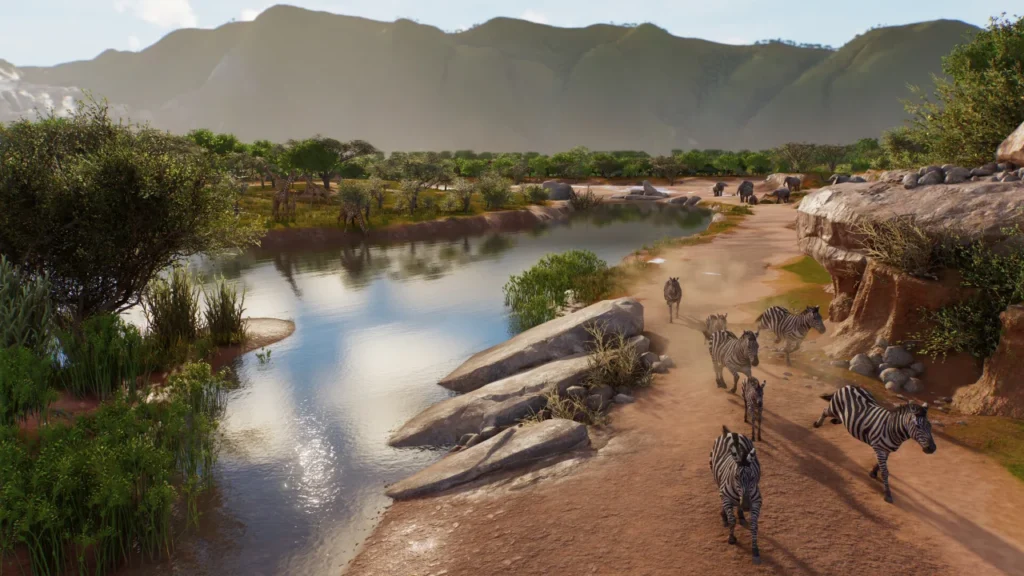
Animals can be bought with either cash or Conservation Credits. Cash animals can’t be released into the wild, and credit animals can. That makes cash the right currency for filling a zoo, and credits the right one for anything you plan to send to a reserve.
You start with 300 credits, and opening another zoo takes 100 of them. Opening a reserve costs the same. Spend all 300 on animals and you’ll be waiting for a sale before you can open the second zoo and first reserve that Tier 3 needs, so keep 200 aside until both are placed.
Cash animals tend to disappear from the market quickly. Animal Storage helps here, because animals waiting in storage don’t age. You can grab a pair when one turns up and bring them into the zoo when the habitat is ready.
Getting a zoo to 3 stars
A couple of well-kept habitats is enough for 3 Reputation stars. The quick wins are animals at thriving status, recycling bins around the paths, renewable power and plenty of education boards. For thriving you need to research the species first.
Stars come from four ratings: Animal Husbandry, Sustainability, Guest Education and Guest Experience. Open Zoo Management, then Overview to see them side by side, and fix the weakest one first. Marketing also feeds your reputation, and you unlock more campaign slots as your tier rises. Pick your most popular animal first and check the price against your balance.
Make one zoo the plain one
Tier 3 and 4 ask for two zoos with stars, but Tier 5 only asks for one at 5 stars. The top rating is a long job, because every rating has to stay high at once. I’d pick one zoo to do that in and keep it plain: cheap habitats, lots of education and facilities, and no worrying about how it looks.
Build the second zoo properly. It reaches 3 stars easily once two habitats are up, and you get to play the part of the mode you actually enjoy. Once the plain zoo reaches 5 stars, you can leave it alone.
Europe’s animals suit the plain zoo well. They’re easy to keep, and they cover the three European reserves (Scottish Highlands, Sweden and Poland), which are a good first stop for releases.
Reserves and Biodiversity stars
A reserve’s Biodiversity Rating comes from two things: the state of its ecosystems and how much research you’ve built there. There are six reserves at launch. They are Great Rift Valley, Tanzania, Sumatra, Scottish Highlands, Sweden and Poland. Each one costs 100 credits to open, the same as a zoo.
- Build the research side first. Place an Observation Platform, and keep platform ranges from overlapping. Camera Traps unlock at Tier 2 and Acoustic Monitors at Tier 3, and each adds to the research rating.
- Add every ecosystem. You need the ecosystem brush for this. Pick an ecosystem from its menu and paint it, and the status should move from Invalid to Established once the terrain fits.
- Clear invasive plants and pollution. This is one of the cheapest ratings to gain, and removing invasive plants alone can bring a reserve close to 2 stars.
- Release animals until ecosystems flourish. An ecosystem flourishes when its roles are filled, however many species you use. Check for one that’s a single animal short.
A species only needs releasing once. If a species is already released in one reserve, send the extras to another reserve that takes it. Juveniles can go into release groups too, so add them from storage and don’t wait for them to finish growing.
Heads up: finalising a release group can’t be undone, so check the members first. Save by hand before you travel to a reserve to confirm a release. Update 1.0.8 fixed animals being lost when the game crashes or disconnects during a release, but a manual save before the trip is cheap insurance.
For your two 5-star reserves, I’d skip Sumatra. Right now it won’t give players a fifth star, so Tanzania, Great Rift Valley and the three European reserves are the safer picks.
Trading, breeding and exhibits
To sell an animal, send it to storage at your Trading Center and list it at a price you choose. While the listing is live, another player can pay your price in credits to take it, and an unsold animal goes back into storage. Trading is limited to healthy adults in stable condition, so juveniles, pregnant animals, old ones and anything sick or hurt can’t be listed. Quick Release also pays credits, and since 1.0.6 quick-sold animals no longer reappear in storage.
The market is slow and a few sellers price high, so set your price a little under what looks fair. A cheap listing beats one that sits there for days.
Exhibit animals (the small ones in exhibit habitats) are an easy source of credits. They breed readily and the young are born as adults, so you can list them straight away. Update 1.0.6 made them breed less often, so don’t plan around a flood.
Use contraception once a habitat is full. Extra animals make habitats dirty faster, which raises disease risk and keeps your staff busy, and it stops siblings and parents from breeding. For fish, a shoal needs at least two to breed, plenty of room and a clean tank.
Getting ready for Tier 5
Ten animals are held back for Tier 5. On land you get both elephants (African Savannah and Asian), the Giant Panda, the Lion, and three apes: the Sumatran Orangutan, Western Chimpanzee and Western Lowland Gorilla. The White-Backed Vulture is the one bird, and the Great Hammerhead and Ocean Sunfish need an aquarium. Since the Lion is on that list, there’s no big cat early on.
You can’t buy them before the tier is done, so there’s no point planning their habitats yet. Working out your fastest breeders is a better use of that planning time.
Good to know
- Connection error on Resume: Hotfix 1.0.7 fixed it. If you still can’t connect, turn off any VPN. If Resume still errors, start Franchise from its button on the main menu instead.
- Update 1.0.6: moved more beginner-friendly exhibit animals and fish species into lower tiers, so Tier 1 has more variety. Credits from exhibit animals now survive a reload.
- Research is shared: every zoo in one Franchise uses the same research, so a vet in one zoo moves all of them forward.
- Next update: Frontier is adding Workshop blueprints to Franchise in its next update, and the ones that need research will say so.
Did this guide help?
Up next in Planet Zoo 2
Something wrong or out of date? Tell us
Guide by
Sunny
Sunny’s favourite game is Stardew Valley, and she has told herself “one more day” about four thousand times. The rest of her time goes on dying in a basement in The Binding of Isaac and planning her whole week around who she’s hanging out with in Persona.
Popular right now
-
GuidesEarly game
-
GuidesEarly game
-
GuidesEarly game
-
GuidesEndgame



Squad chat
Be the firstStart the chat